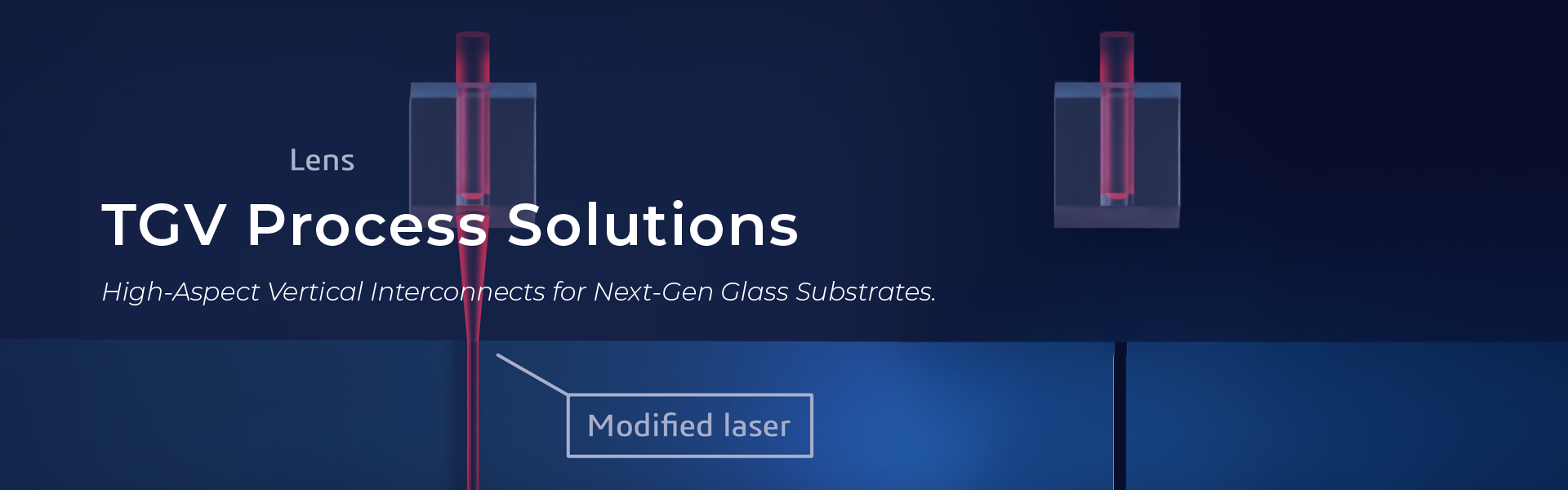
TGV Drilling Technology

MOL Solutions' single-shot TGV laser drilling technology utilizes spatiotemporally modulated laser pulses to create modified through-channel tracks in a single pulse, followed by selective chemical etching to form uniform, straight cylindrical through-glass vias (TGVs). Featuring ultra-high-speed via formation, minimal heat-affected zones (HAZ), and exceptional profile consistency, it is ideally suited for advanced packaging and high-volume manufacturing of high-density glass substrates.

TGV LASER DRILLING TECHNOLOGY

High-Speed Single-Shot Through-Glass Via Technology

This high-speed TGV laser-drilling process combines spatiotemporally modulated laser pulses with optimized chemical etching. The technology increases drilling throughput while improving via geometry, sidewall quality, and process uniformity for large-area volume manufacturing.

SINGLE-SHOT DRILLING

Single-Shot Through-Drilling Technology

The key feature of this TGV laser-drilling technology is Single-Shot Through Drilling. Unlike conventional methods that use multiple consecutive laser pulses from both sides of the glass, MOL applies a specially engineered spatiotemporally modulated laser pulse to form a pre-through hole connecting the top and bottom surfaces with a single laser exposure. This eliminates repetitive ablation and double-sided alignment.

SPATIOTEMPORAL PULSE CONTROL

Spatiotemporally Modulated Laser-Pulse Drilling

During processing, the leading portion of the pulse excites electrons within the glass and establishes an elongated filamentary energy channel. The trailing energy is then efficiently absorbed by the excited region, producing selective heating and concentrating the laser energy along the predefined drilling path. This mechanism instantaneously forms a pre-through hole with a diameter greater than 10 µm.

Single-shot hole formation substantially reduces the processing time per via while minimizing heat accumulation, microcracks, debris, top-to-bottom positional offset, and via-profile inconsistency associated with multi-pulse processing.

CHEMICAL ETCHING

Chemical Etching and Cylindrical TGV Formation

After the pre-through hole is formed, an optimized chemical-etching process uniformly enlarges the via diameter to more than 50 µm. The etching step simultaneously refines the sidewalls and improves surface quality, producing straight and uniform cylindrical TGVs.

Compared with consecutive multi-pulse drilling from both sides or laser-induced deep etching (LIDE), the MOL process can increase overall processing speed by up to 10×. It also reduces center-junction irregularities, V-shaped depressions, and insufficient sidewall verticality.

HIGH-VOLUME MANUFACTURING

High-Throughput Volume Manufacturing

At a 50 µm pitch, the laser hole-formation rate can exceed 14,000 vias per second. When integrated with a high-speed galvanometer scanning system, throughput can exceed 90,000 vias per second. The process is also compatible with glass substrates thicker than 500 µm.

Process Performance Highlights

> 10 µm
Pre-Through-Hole Diameter
> 50 µm
Via Diameter After Chemical Etching
Up to 10×
Overall Process-Speed Improvement
> 90,000
Maximum Laser Drilling Rate (Vias/s)
> 500 µm
Supported Glass-Substrate Thickness
Manufacturing Value | The integration of single-shot drilling, spatiotemporally modulated laser pulses, and optimized chemical etching reduces the processing time per via while minimizing heat accumulation, microcracks, debris, and positional offset. It also improves process uniformity and manufacturing efficiency for large-area TGV production.
CPO OPTICAL ALIGNMENT TECHNOLOGY

TGVs for Fiber Retention and Precision Alignment in CPO

TGV fiber retention and precision alignment in CPO

In Co-Packaged Optics (CPO) assemblies, TGVs can provide more than electrical interconnection. They can also be fabricated without copper metallization and used as fiber-alignment through-holes. Rather than carrying electrical current, these openings allow bare optical fibers to be inserted vertically into a glass interposer.

The position, diameter, and verticality of each glass through-hole precisely constrain the fiber position, enabling the fiber core to align with grating couplers or other optical coupling structures on the photonic integrated circuit (PIC). This configuration provides stable and repeatable vertical optical coupling.

After removal of the outer coating, a standard single-mode fiber typically has a glass-cladding diameter of approximately 125 µm. The alignment-hole diameter is therefore designed slightly larger than the fiber cladding to accommodate dimensional variation, insertion tolerances, and adhesive clearance.

Multiple TGVs can be arranged at a fixed pitch to form one-dimensional or two-dimensional fiber arrays. This architecture can simultaneously retain dozens of optical channels and support high-density vertical optical coupling between the fiber array and the PIC. The glass interposer can also integrate fiber insertion holes, glass waveguides, and micromirrors to route optical signals from multicore fibers to grating couplers on a silicon photonic chip.

During assembly, the fibers are inserted into the alignment holes from the top of the glass interposer. After the insertion depth is adjusted, the fibers are secured using low-shrinkage UV-curable adhesive or optical-grade bonding material.

The dimensional stability of glass allows the through-hole array to directly define the position of each fiber, reducing the time required for individual active alignment while improving CPO optical-engine assembly throughput, repeatability, and consistency. Positioned between the fiber array and the PIC, the glass interposer provides a high-channel-count precision optical-alignment platform.

Fiber-Alignment TGVs125 µm Single-Mode FiberHigh-Density Fiber ArraysFiber-to-PIC CouplingPassive Precision AlignmentCPO Optical Engines
VIDEO 01

TGV 製程展示

VIDEO 02

One-Shot TGV: Laser Drilling & Wet Etching